How to Organize an "Eye Break" at Home That Your Child Will Want to Join
Every parent who has tried to tell their child, "now it's break time, rest your eyes," knows this resistance. It sounds like just another obligation, another "don't do what you enjoy." Yet the very idea — a regular break from close visual work — is one of the best-documented methods for protecting vision, known from the 20-20-20 rule.
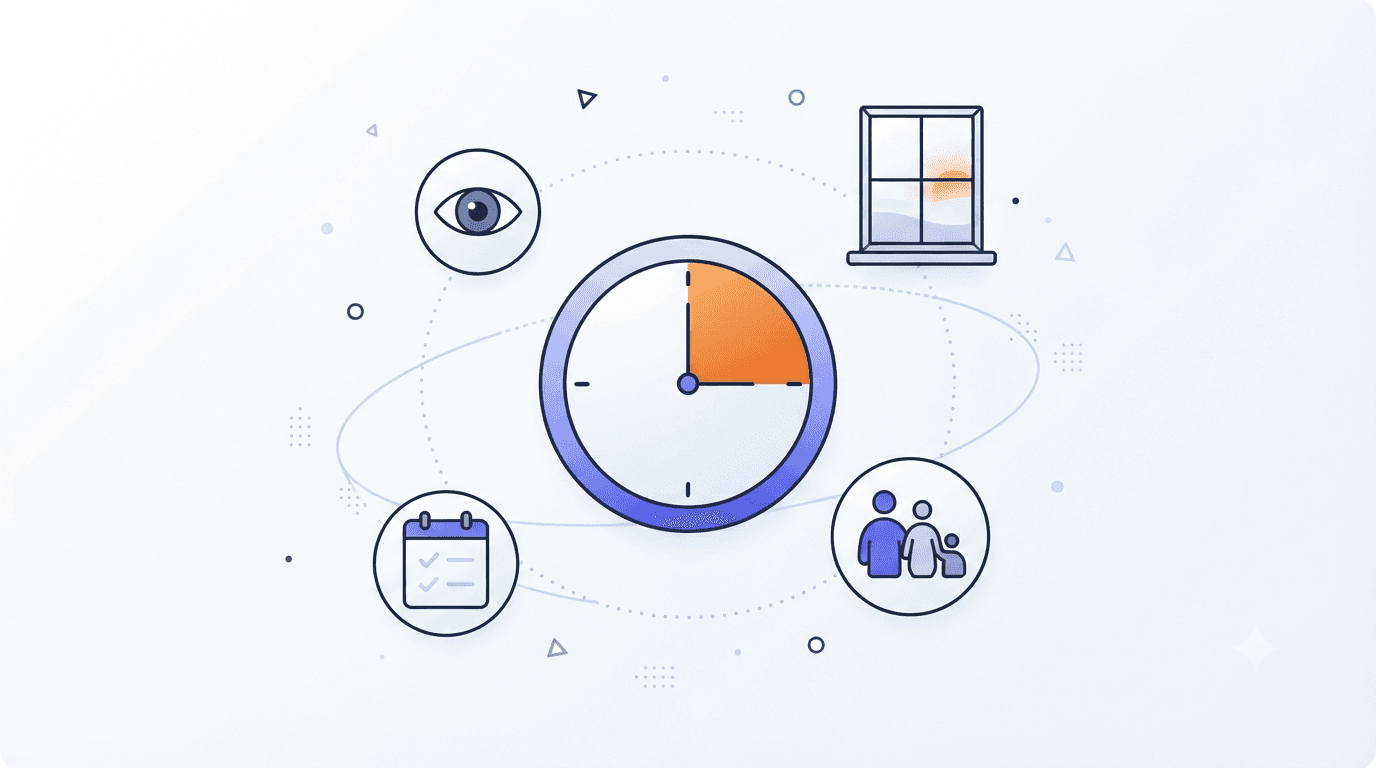
The problem lies not in the idea of a break itself, but in how it is communicated and how it looks in practice.
Why "take a break" doesn't work
Stated directly as a command, an eye break sounds like something taken away rather than given — another thing the child "must" do, interrupting something enjoyable (a game, a cartoon). It's natural that it meets with resistance.
A key shift in perspective: an eye break works best when it is not a break from something enjoyable, but becomes something enjoyable in itself.
What it looks like in practice — a few proven approaches
Ritual, not command. Children (and adults) are more likely to accept something that has a consistent, predictable rhythm than something that appears unexpectedly as a mandate. If the eye break happens at the same time, in a similar way, it becomes part of the day — not a punishment.
Element of fun instead of instruction. "Look into the distance for 20 seconds" is an instruction. "Find three things that are blue, as far as you can see" is a game. The same physiological effect (looking into the distance, relaxation of accommodation), but a completely different experience for the child.
Engaging the whole body, not just the eyes. A short movement, stretching, a few steps to the window — a break that combines physical movement with visual rest is more engaging than static "just look somewhere else."
Parental participation. If the eye break is something only the child does while the parent continues to look at their phone, the message is mixed. A few seconds of looking into the distance together, breathing together, builds more than just the physiological benefit for vision.
Short and regular, not long and rare. An eye break doesn't have to last long to be effective — the key is regularity, not length. A few seconds every now and then during screen time or homework does more than one long break once a day.
A Simple Scenario for a Home Eye Break (5 Minutes)
- 1One minute of movement — a few steps, stretching, opening a window
- 2One minute of looking into the distance — in the form of a game ("find something green as far away as you can"), not an instruction
- 3One minute of conscious blinking — more on this in the article about blinking and mindfulness
- 4A moment of breathing — a few calm inhales and exhales, eyes closed or looking into the distance
- 5Return to the activity — without the feeling that something has been "taken away"
Why it's worth having a ready tool instead of improvising every day
Coming up with a new game for a break every day is exhausting for a parent — and this is exactly the moment when good intentions often get lost in daily chaos.
Information: ocu•vio does not diagnose or treat vision problems. It is a tool supporting daily prevention, healthy habits, and visual comfort for the whole family.
Read also
Magdalena Ojrzyńska — founder of ocu•vio
Return to the blog