Eye Yoga: Where Does That Sense of Calm Come From?
End of the day. You put down your phone, close your eyes for a moment, and place warm hands over your eyelids. Or you simply approach the window and gaze at something far away. After a minute, something unexpected happens: it gets quieter. Not in the room — in your mind.
Is ‘eye yoga’ something real?
It is neither a discipline nor a technique from a textbook. It’s a colloquial term that has stuck to brief exercises and moments when we consciously change the way we look.
The association with yoga does not come from technique. It comes from how it feels — and that’s why people reach for this comparison themselves before anyone suggests it.
Where Does That Sense of Calm Come From?
Several things happen at once, and none of them are particularly mysterious.
The eyes stop maintaining one distance. For most of the day, you look at something that is a few dozen centimeters from your face: a screen, paper, another screen. Looking into the distance or closing your eyelids interrupts this continuity.
Blinking slows down. During focused work, we blink less and more shallowly. When you start doing it consciously and slowly, the rhythm naturally evens out.
Attention stops jumping. Throughout the day, your gaze jumps between windows, notifications, and tasks. Stopping it on one point — or in the darkness behind your eyelids — is something different for attention than everything it has done before.
And finally, breathing. It’s hard to do any of these things in a hurry, so breathing slows down as a result.
What Does This Have to Do with Mindfulness?
More than it seems.
Looking is a form of attention. You decide where to direct it, how long it stays there, and whether it returns to the same place. When you do this consciously, you perform exactly the same action as in mindfulness exercises — only the tool is your eyes, not your breath.
That’s why these two things connect so well. There’s no need to reconcile them, as they are essentially one activity.
How Does It Look in Practice?
Three things, each of which can be done in a minute.
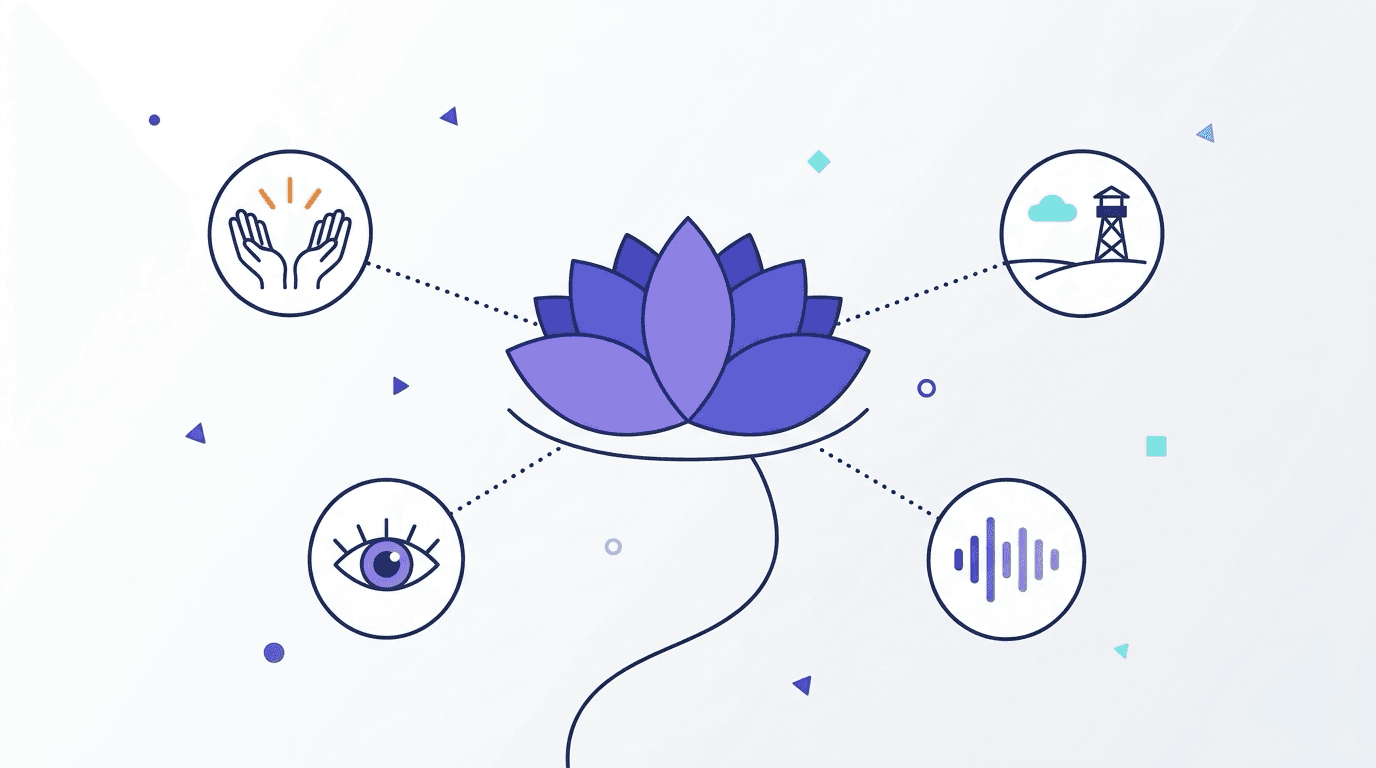
Warm hands on your eyelids. Rub your hands together, place them over your closed eyes without pressing on the eyeballs, and stay like that for a few breaths. Darkness and warmth do the work on their own.
The furthest point in your line of sight. Approach the window and find something really distant: a chimney, a tree, a tower, a cloud. Look at it calmly for a moment, without searching for details.
Five slow blinks. As if your eyelids were taking pictures. No squeezing and no rushing.
You can do one of these or all three. There’s no order to remember.
What This Does Not Replace
This is not a remedy and does not replace an eye examination. If your eyes get tired every day, the image may be blurry or headaches return, it’s worth scheduling an appointment with an eye care professional or orthoptist — even if everything has been fine so far.
These few minutes are something different: a break in a day when everything happens at one distance.
Because taking care of your eyesight doesn’t have to look like another task. Sometimes it looks like a moment of silence.
This material is for informational purposes only and does not replace consultation with a specialist.
Read also
Magdalena Ojrzyńska — founder of ocu•vio
Return to the blog