Four Things You Can See Before a Child Says They See Worse
A child rarely says they see worse — not because they are hiding it, but because they have nothing to compare it with. The first signals are usually in behaviour.
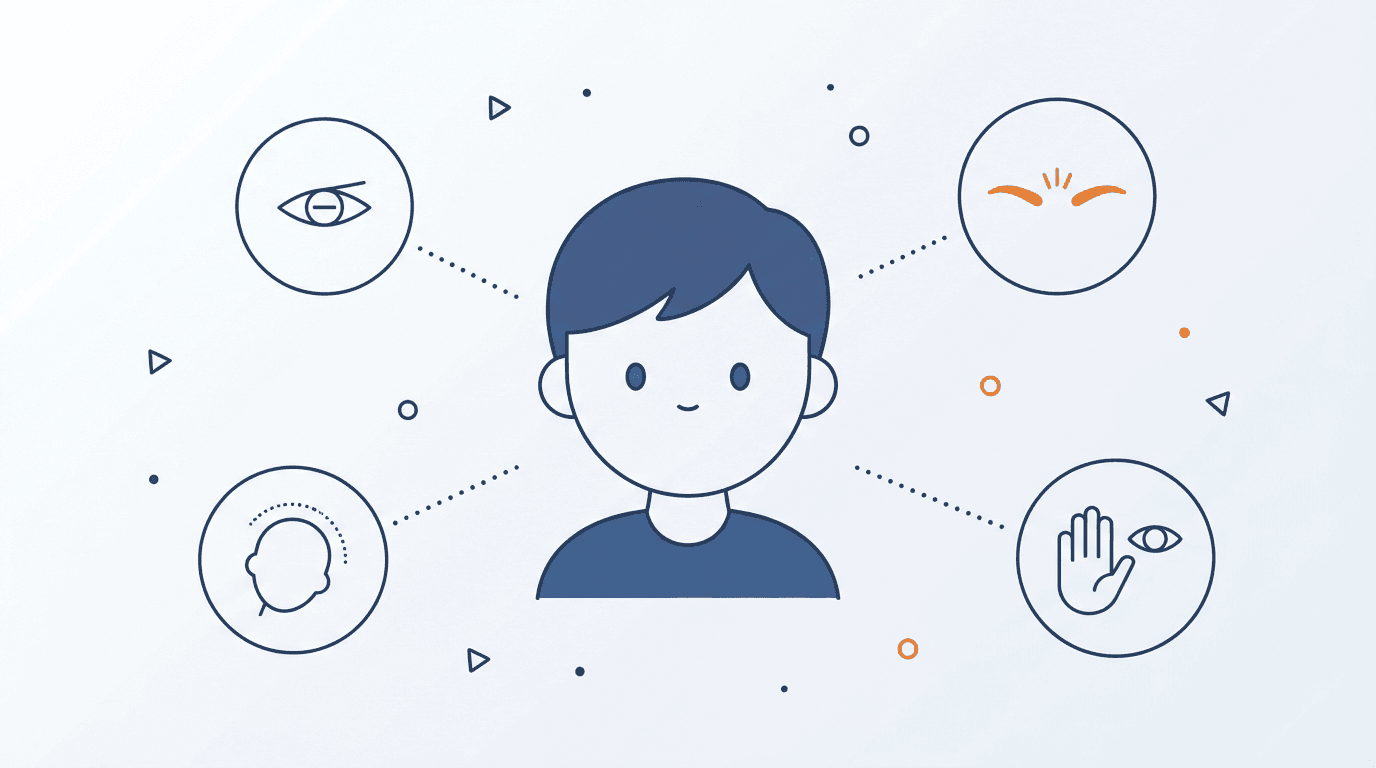
The world has always looked the same, so there is no reason to suppose it could look any different.
The first signals are therefore usually not in words, but in behaviour. And they are things you can notice at home, during ordinary everyday activities — over a book, over a tablet, while drawing.
The four below come up most often in descriptions of symptoms.
1. Squinting
The best-known signal and at the same time the one most often explained away as something else: the sun, tiredness, habit.
Squinting works like a makeshift aperture. Narrowing the gap between the eyelids reduces the amount of light entering the eye and briefly sharpens the image — which is why a child who sees worse discovers this trick on their own, without anyone suggesting it. They do what works.
Among the typical symptoms of myopia, squinting is listed alongside difficulty copying from the board, moving closer to objects, and eye and head pain [1].
What to look out for at home: whether the squinting appears in particular situations — in front of the television, at the board, when looking at something far away. If it is always in the same circumstances, it is worth remembering.
2. Frowning
This signal almost never comes up in conversations between parents, yet it is listed among the symptoms worth attention, alongside squinting, rubbing the eyes and moving closer to a book [2].
A child who spends a long time trying to pull out a sharp image tenses the muscles of the face. The effect shows on the forehead and between the eyebrows — a look of concentration that in a small child simply reads as seriousness, or as annoyance.
What to look out for at home: whether that expression appears during tasks that require looking. Over a book, while drawing, in front of a screen. Not during physical play.
3. Head tilting
The most telling of the four, and the one most often taken for a habit.
A head held constantly to one side can be the way a child looks for the position in which they see best, or most comfortably. Head tilting and squinting are described outright as attempts at compensation — the child is looking, on their own, for the position in which the image is more bearable [2].
That head position matters enough that the guidelines on managing strabismus list its presence among the indications for starting treatment, precisely because of the consequences for body posture [3].
And this is the point at which vision stops being a matter of the eyes alone. A head held constantly at an angle means a neck that works differently, shoulders set differently, a different distribution of tension throughout the body.
What to look out for at home: whether, in photographs from the past year, the head is always held in a similar way. The album on your phone can be a better observation tool than memory.
4. Closing or covering one eye
The fourth signal differs from the others, because it concerns only one eye.
Covering or half-closing one eye while looking is listed among the symptoms that require attention [2]. A child may be dealing this way with an image that refuses to come together — instinctively, without realising they are doing anything unusual. The mechanism that can lie behind this has a name: suppression.
It also happens that it is not about covering the eye with a hand, but about a subtler version: the child turns their head so that one eye falls outside the field of view.
What to look out for at home: whether, while reading or watching something, a hand appears next to the face always on the same side.
What this does not mean
None of these four signals is a diagnosis. Each may have an entirely different cause — from tiredness, through habit, to muscle tension unrelated to vision.
Nor does it mean you have missed something if you did not notice them earlier. What we see every day stops standing out — not from lack of attention, but because that is how familiarity works. The person carrying out the examination sees the child for the first time, and with hundreds of others for comparison. A parent has seen them forever.
What it does mean is this: if one of these signals keeps recurring and is tied to particular situations, it is worth checking.
What is worth having ready for the appointment
The opening part of the examination is usually a conversation. The questions can be detailed and reach far back, so it is easier when the answers have been thought through in advance.
Some of the following usually come up:
- whether anyone in the family had a squint or wore glasses from childhood
- whether you have ever noticed one eye drifting, and since when
- whether it appeared suddenly or built up gradually
- how the pregnancy and birth went
- whether the child has worn glasses before, and after what kind of examination they were fitted
Two things are worth taking along: the previous glasses, if there were any, and records from earlier examinations. Even an old sheet from a health check-up can be useful, because it gives a point of reference.
It is also worth knowing that a reliable assessment of a child's refractive error requires instilling drops that paralyse accommodation. Without this, the young eye can partly compensate for the error and the result will be understated [1].
When not to wait
A separate matter concerns the youngest children. Intermittent drifting of the eyes in a newborn is common and should not be a cause for concern. Correct coordination of the movements of both eyes appears, however, around the second month of life, and full motor fusion should be developed in all infants from the fourth month. Any squint found after that age requires a full ophthalmological examination [3].
This is the boundary at which "let's wait, maybe it will pass on its own" stops being a good strategy.
And day to day
Observation is one thing. Everyday life is another — and here a parent has real influence.
For most of the school day a child's eye works at a single, close distance: the exercise book, the board, the screen. What relieves it is change — a look further away, movement of the eyes, a moment's break, a conscious blink. Simple things, which we do naturally, only less often than the eye needs.
The hard part is not knowing about them. The hard part is remembering every day, when the child still has two exercises left to do. That is why ocu•vio came about — everyday vision habits in a ready-made form, in three age zones, with screen-distance control and a library of printable materials. One subscription covers the whole family.
[1] Medycyna Praktyczna, 5000 pytań z pediatrii [5000 Questions in Paediatrics] — refractive errors section: symptoms suggesting that the error is being compensated by accommodation, and the need for examination after paralysing accommodation.
[2] Medycyna Praktyczna, Objawy wad wzroku u dzieci [Symptoms of Refractive Errors in Children] — patient service, ophthalmology section.
[3] Polskie Towarzystwo Okulistyczne (Polish Ophthalmological Society), Section of Paediatric Ophthalmology and Strabismus, Wytyczne postępowania w zezie [Guidelines on the management of strabismus], 2021.
This material is for information only and does not replace a consultation with a specialist. If you have any doubts about your child's eyesight, it is worth contacting an ophthalmologist, an optometrist or an orthoptist.
Read also
Magdalena Ojrzyńska — founder of ocu•vio
Return to the blog